
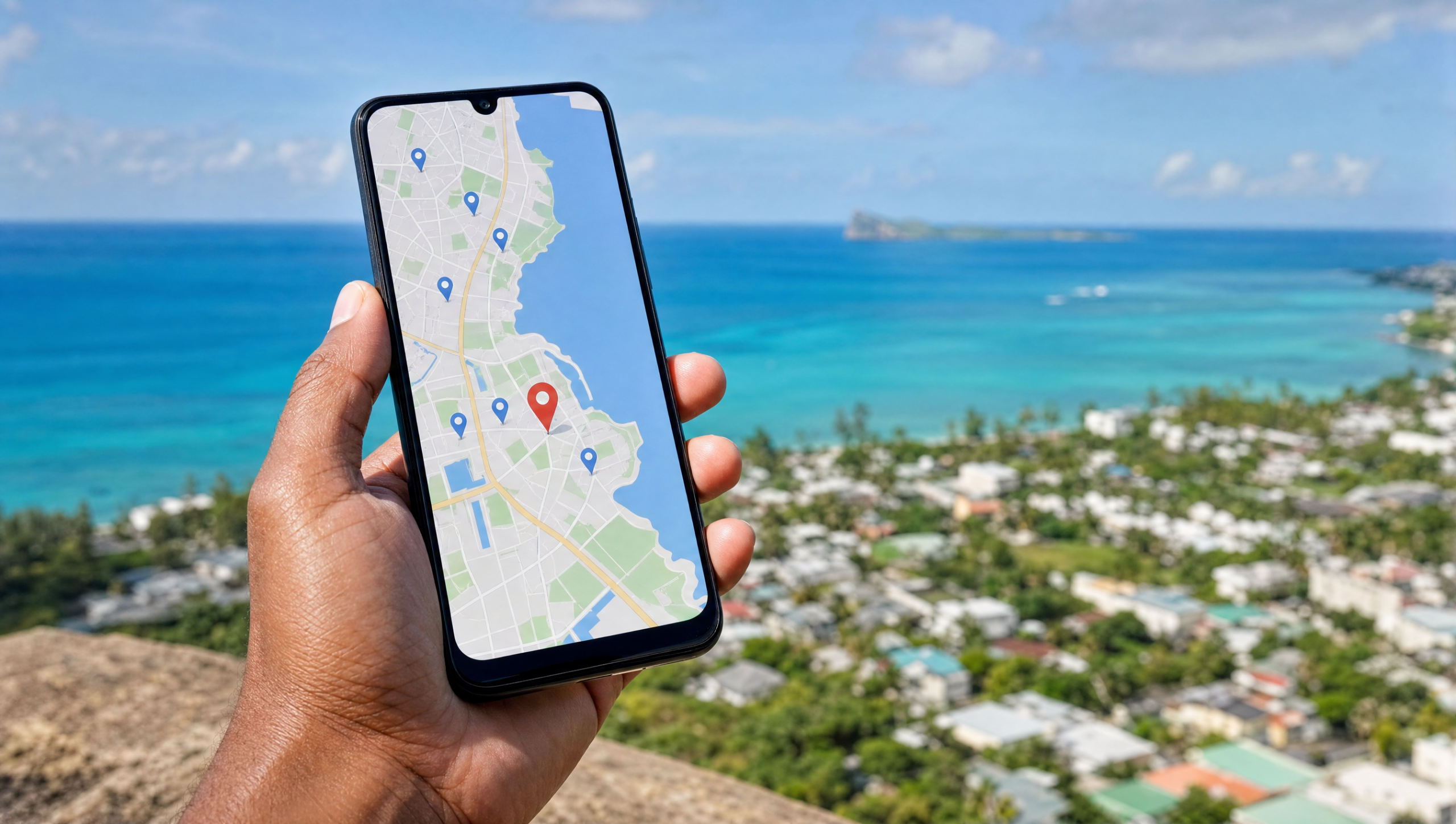
Why GEO matters more than SEO in Mauritius
Traditional SEO fights for rankings on a national or global stage. GEO — Geographic Engine Optimisation — fights for the three pins in the Google Maps Local Pack. In a country with 1.27 million people and 25 commercially relevant towns packed into 2,040 square kilometres, GEO is not a sub-discipline of SEO. It is the main event. The Mauritian SME competes in a micro-market. The Curepipe physiotherapist does not compete with a physiotherapist in Grand Baie. They are in different catchment areas, serving different populations, and appearing in different Local Packs. Ranking in the national organic results for “physiotherapist Mauritius” is a nice-to-have. Ranking in the Local Pack for “physiotherapist Curepipe” is the business.The 7km radius
We observe across client accounts that the vast majority of service-business search clicks in Mauritius land within a 5–7 km radius of the user’s location — consistent with global near-me search patterns and the physical geography of the island (Digital Growth internal observation, May 2026). For restaurants, that radius compresses further: a Grand Baie diner searching “restaurant near me” is not evaluating options in Ebène. 88.6% of Mauritian households own a smartphone (Mauritius Digital Promotion Agency, 2024), and 2.14 million mobile connections serve a population of 1.27 million — 168% penetration, with multi-SIM ownership common (DataReportal, January 2025). Searches happen on the move, in the car, in the queue, from the hotel room. By the time someone types a near-me query, they have already decided they want something. They are choosing who to buy it from. The business that appears at the top of the Local Pack wins that choice. Not the business with the most expensive website. Not the business running the most Meta ads. The business with the best-optimised Google Business Profile, the most recent reviews, and the most relevant categories.The GBP-vs-website value swap
Here is something most agencies won’t say directly: for restaurants, salons, clinics, garages, and most retail businesses in Mauritius, the Google Business Profile receives more direct calls, clicks for directions, and table bookings than the website. That does not mean your website doesn’t matter. It means your website’s primary job has changed. It is now a credibility document for your GBP — a place Google sends sceptical searchers who want to know more before they call. The conversion happens on the GBP. The website confirms the decision. This reframing matters for budget allocation. Spending MUR 200,000 (approx. USD 4,300) on a website redesign while your GBP has 12 reviews from three years ago and incorrect opening hours is the wrong order. Fix the GBP first.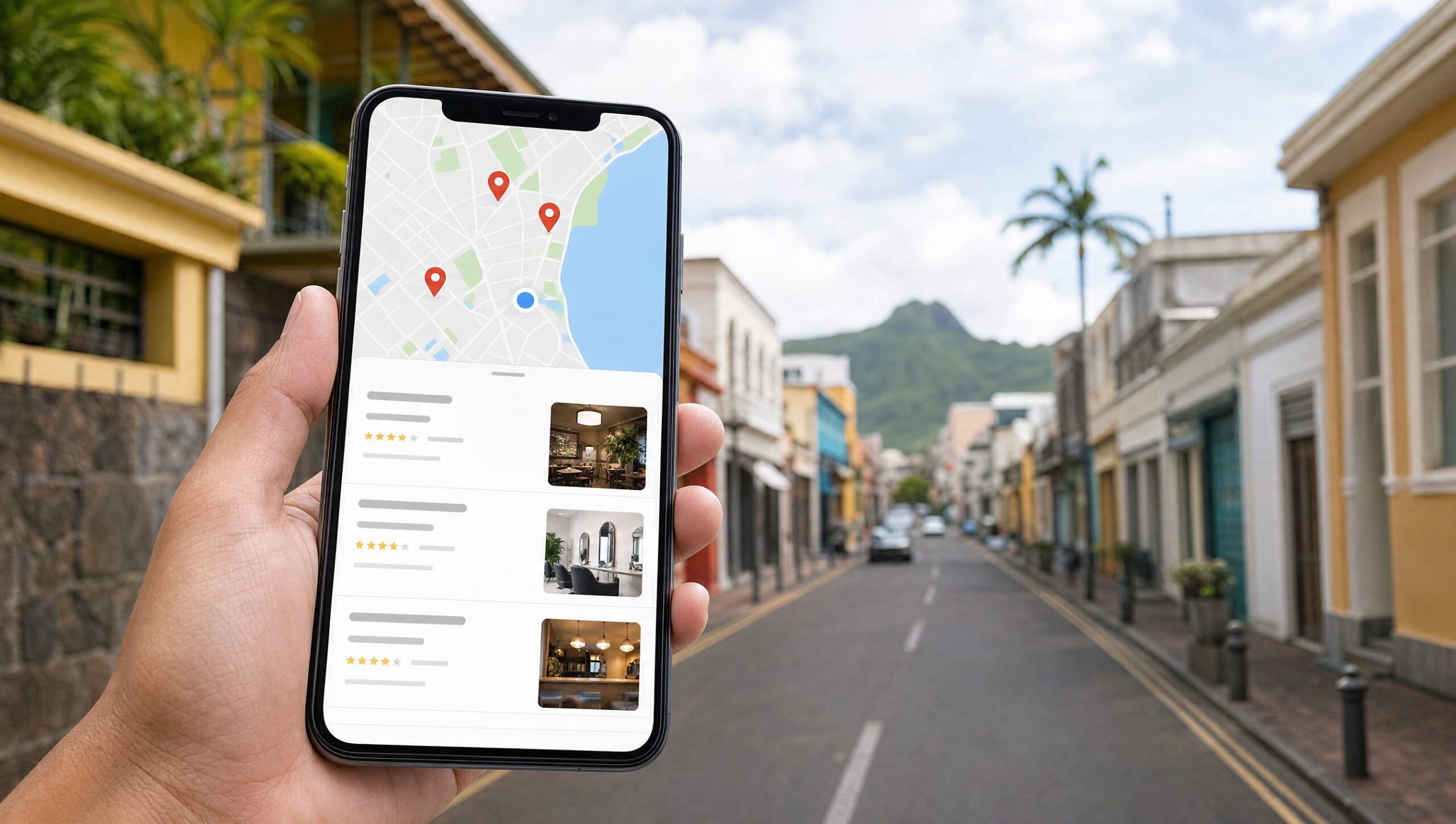
The Google Business Profile playbook
A GBP profile is not a directory listing. Treated as one — with basic NAP (Name, Address, Phone) data and nothing else — it performs like one: poorly. Treated as a living, managed property with a publishing cadence, it performs like a channel. Here is how Mauritian SMEs should build and run it.Setup and verification (including common MU suspension causes)
First, claim the right profile. Search your business name on Google Maps before creating anything new. Duplicate profiles are one of the most common problems we audit in Mauritius — a business that moved addresses two years ago often has two profiles (old and new), and Google’s algorithm treats duplication as a quality signal problem. Verification. The standard postcard verification takes 7–14 days to arrive in Mauritius. Video verification (increasingly the default in 2025–2026) requires a short walkthrough of the physical premises and has a faster turnaround. Use video where available. NAP consistency. Your business name, address, and phone number must be identical — character for character — across your GBP, your website, your Yellowpages.mu listing, your MCCI directory entry, and every other directory. “Rue La Paix” and “La Paix Street” are not the same to Google. Inconsistent NAP is consistently the second or third item flagged on every local search audit we conduct (Digital Growth internal benchmark, May 2026). Common MU suspension causes. From Digital Growth’s GBP audit work across Mauritian SMEs, profile suspensions are among the most common issues we encounter. They are typically triggered by:- Address verification failures — Google cannot confirm the business address against its own data, often because the address format used in Mauritius (lot numbers, residential area names, no street numbers in some towns) doesn’t match Google’s expected structure.
- Duplicate listing conflicts — the same business appears twice, usually because a previous owner, staff member, or agency created a profile that was never removed.
- Category mismatch — a restaurant listed as “food” rather than a specific cuisine category can trigger a review for violating guidelines.
- New or changed location — businesses that move without properly transferring their GBP often have the old profile suspended and lose all their reviews in the process.
GBP Suspension Recovery Checklist
- Identify the suspension type — “soft suspended” (profile still shows but owner access is revoked) vs “hard suspended” (removed from Maps entirely). Check via Google Business Profile Manager.
- Fix the triggering issue — verify your address matches exactly on your website, business registration documents, and utility bills. Remove any duplicate profiles you have access to.
- Submit a reinstatement request — via the Google Business Profile Help form (not the general Google support form). Attach supporting documentation: business registration certificate, proof of address, a photo of your shopfront with the street visible.
- Follow up in 14 days — Google’s reinstatement timeline in Mauritius is typically 5–21 business days. If there is no response after 14 days, resubmit the same request with an additional supporting document. Do not submit multiple simultaneous requests — it resets the queue.
Categories, services, products
Your primary category is the single most important editable field in your GBP. Google uses it to determine which searches you are relevant for. Choose the most specific primary category available — not “restaurant” if you can choose “French restaurant” or “seafood restaurant”. You can add up to 9 secondary categories. Use them. A spa that also offers massage therapy, beauty treatments, and nail services should list each separately. Services. Fill out the Services section completely with real service names and descriptions. This is where you can use natural-language terms that match how customers search — “deep tissue massage in Quatre Bornes” rather than just “massage”. Character limits are generous; use them. Products. If you sell physical goods, the Products module shows them directly in your GBP panel. For a Mauritian retailer competing with larger chains, this is underused and high-impact.Posts, offers, photos cadence
Google posts expire after 7 days (for standard posts) or when the offer ends. Most Mauritian businesses post once, decide it “didn’t work”, and stop. That is the wrong conclusion. The minimum effective cadence for a Mauritian SME is:- 1 post per week — either a current offer, a seasonal update, or a product/service highlight
- 4–6 new photos per month — interior shots, food/product shots, team photos. Cover photos should rotate every 4–6 weeks.
- Update hours immediately for public holidays — Mauritius has 15 national public holidays; failing to update for Divali, Eid, or Chinese New Year when a tourist searches on that day is a conversion lost.
Q&A and review management
The Q&A section of your GBP is searchable. Questions users ask — “Do you have parking?” “Is the pool heated?” “Do you accept MCB Juice?” — appear in your profile and affect how Google matches queries. You do not have to wait for customers to ask them. You can seed your own Q&A with the questions you actually get asked most. Answer every question. Flag and remove spam (Google allows business owners to report inappropriate Q&A). This section is low-maintenance but consistently ignored.Reviews as compound trust
Reviews are not a vanity metric. They are a ranking signal, a conversion factor, and — increasingly — a citation source for AI-generated answers. Globally, review count accounts for approximately 19.2% of ranking influence in the Local Pack (Local Falcon, 2025 — global figure). That figure rises to 26% among the top-ranked businesses. Reviews are the controllable ranking lever with the fastest return. According to ReviewTrackers (October 2023, global figure), 63.6% of consumers check Google before visiting a business, and consumers typically need to see approximately 112 reviews before they trust the aggregate rating as authentic. The Mauritian SME with 80 four-star reviews is more trusted — and better ranked — than the competitor with 6 five-star reviews and a nicer logo.The Mauritian SME review playbook (cadence, scripts, QR workflow)
Reviews do not accumulate automatically. They require a system. The most effective system for Mauritian SMEs combines three touchpoints: a verbal ask at the point of transaction, a WhatsApp follow-up within 24 hours, and a QR code at the counter for walk-in customers. Quarterly target: For a new or under-reviewed business, the goal is 20 new reviews per quarter. At steady state, 8–12 per quarter maintains freshness. Google’s algorithm weights recency — a business with 30 reviews from 2022 is at a disadvantage against one with 20 reviews from the past 90 days. The WhatsApp review-request script:
English:
“Hi [Name], thank you for visiting [Business Name] today. We’d love your feedback — could you leave us a quick Google review? It takes about 1 minute and helps us a lot: [Google Review Link]. No pressure at all — thanks again!”
Français:
“Bonjour [Prénom], merci d’avoir visité [Nom de l’entreprise] aujourd’hui. Votre avis nous serait très précieux — pourriez-vous nous laisser un avis Google rapide ? Ça prend environ 1 minute et ça nous aide beaucoup : [Lien avis Google]. Merci encore !”
Kreol:
“Bonzour [Lizié], mersi pou ou vizit kot [Non biznes] zordi. Si ou kapav lès nou enn ti komanter lor Google, sa pou ed nou boukou : [Lien]. Pa obligatwar — mersi ankor !”
QR code workflow. Generate a direct QR code to your Google review form (free via Google Business Profile Manager → Get more reviews → Share review form). Print it on a small card or laminated table tent. Place it at the till, on the receipt, or on the restaurant table. For services with waiting areas — clinics, salons, garages — mount it in the waiting area with a brief line: “Enjoyed your visit? Tell us on Google.”
Responding to reviews in EN, FR, and Kreol
Responding to reviews is not optional. Google explicitly recommends it. The response signals to Google that the profile is actively managed — and signals to future customers that the business cares. For positive reviews: Thank the reviewer by first name. Mention a specific detail from their review (shows it’s not a template). Mention the business name and location naturally — this adds a keyword signal. For negative reviews: Respond within 24 hours. Do not get defensive. Acknowledge the experience, offer a resolution, and invite the reviewer to contact you directly. Never argue publicly. The audience for your response is every future reader, not the original reviewer. Language match: Respond in the language the review was written in. A French-language review deserves a French-language response. A Kreol review (increasingly common) should receive at least a partial Kreol response — even a sentence of “Mersi pou ou komanter” before transitioning to French signals respect for the reviewer’s language choice.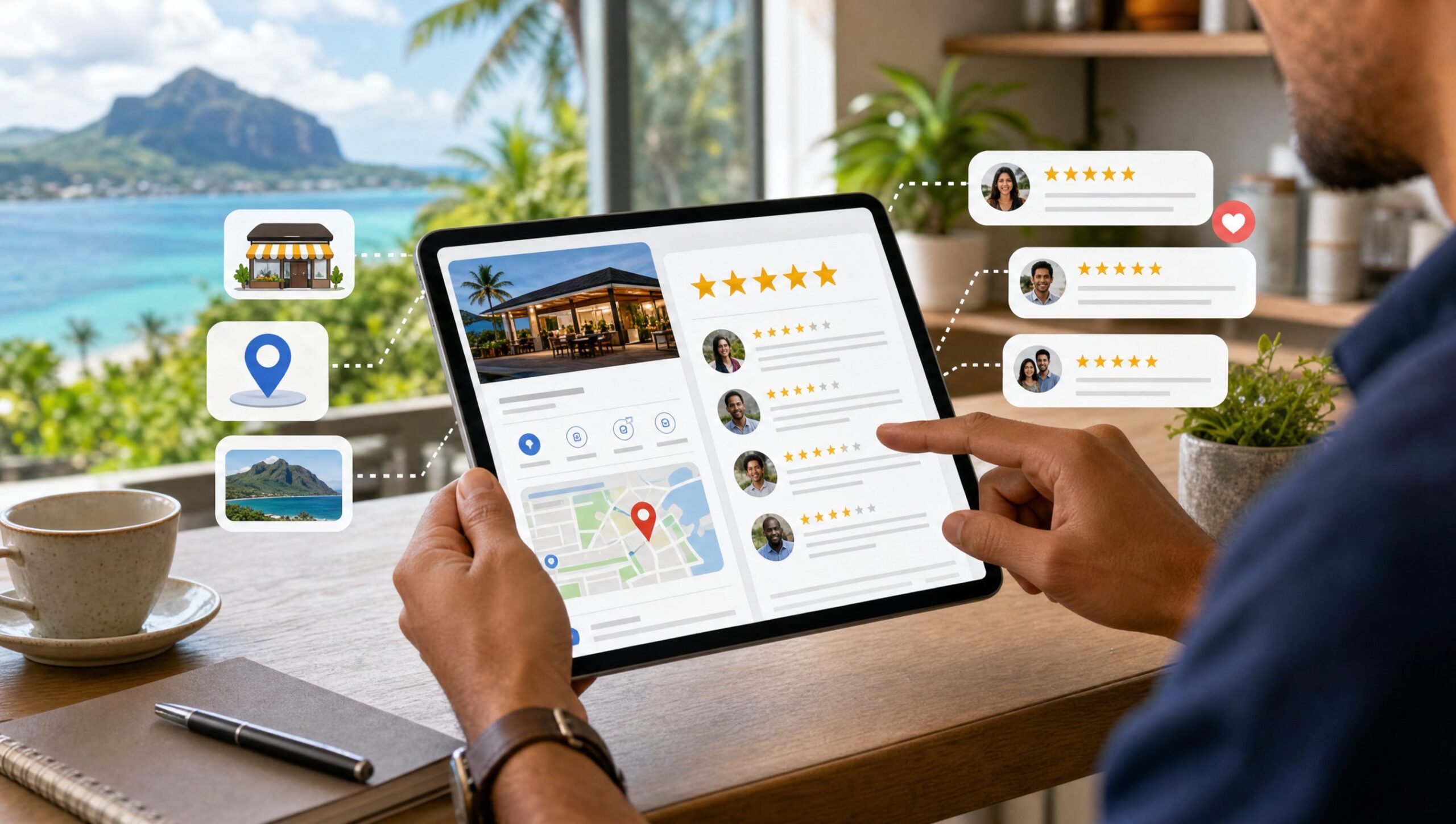
Location landing pages: the programmatic engine
A single GBP profile can only rank in one primary location. A business with four locations needs four GBP profiles — one per location, each with a unique address, unique phone number, and unique landing page URL. That landing page URL is the location landing page. These pages are how a business scales its GEO presence systematically. Each page targets one “[service] in [town]” combination, acts as the GBP destination URL, and feeds cluster authority back to the main site.The “[service] in [town]” template
The template for each location landing page should include:- H1 with the target phrase — “Hair Salon in Curepipe” or “Coiffeur à Curepipe” for FR
- Opening paragraph with genuine town context — not just the keyword repeated, but something true about the town
- Service description — what you offer at this specific location
- Opening hours — must match the GBP
- Address and embedded Google Map — with schema markup
- Team/photos — at least 3 images specific to this location
- Reviews from this location — pull from the GBP (with permission)
- FAQ block — minimum 4 questions, 2 of which should be location-specific
- CTA — phone number, booking link, or WhatsApp button
Avoiding duplicate-content penalties
The most common mistake with programmatic location pages is templating so aggressively that every page becomes a thin clone. Google’s Helpful Content systems (updated in 2024–2025) penalise pages that exist solely to capture a keyword with no unique value for the specific location. Each location page must have a minimum of 40% content that is unique to that town. That 40% comes from: named local landmarks or context, town-specific FAQs, photos taken at or near the specific location, opening hours that may differ by location, and any local partnerships or offers exclusive to that branch. If you cannot write genuinely unique content for a location, do not publish the page. A thin location page that gets de-indexed harms the domain’s overall authority.Internal linking for cluster authority
Every location landing page should: link to the parent service page (/services/geo/); link to 1–2 sibling location pages in the same region; and receive a link from the parent service page and from any relevant cluster posts. This creates the internal linking structure that allows a pillar page to pass authority down to location pages, and location pages to signal relevance back up. The accumulation effect is significant over 12 months — each new location page strengthens the authority of every other page in the cluster.AI search visibility for Mauritian businesses
AI Overviews — Google’s AI-generated answer blocks that appear above organic results — now appear in approximately 40.2% of local business queries globally (Local Falcon, May 2025 — global figure; no Mauritius-specific equivalent verified). For queries that include a specific location name, the appearance rate is approximately 35%.
AI Overviews: Mauritius benchmark
Global benchmark: AI Overviews appear in approximately 35–40% of local business queries that include a location name (Local Falcon, May 2025 — 60,000 searches analysed; global figure).
Mauritius internal benchmark: In Digital Growth’s analysis of “best [service] in [town]” queries across Mauritius (Q1 2026), AI Overviews cited identifiable Mauritian sources in approximately 22% of cases. The remaining 78% of answers drew on generic content or returned no cited source.
The implication: The 78% represents businesses that do not yet exist in the AI’s source pool. For businesses that act in the next 12–18 months, the first-mover advantage in Mauritian AI citations is real and measurable.
The counterintuitive finding from Local Falcon’s research: proximity has almost no impact on which businesses get cited in AI Overviews. The study found a correlation of 0.001 between a business’s proximity to the searcher and its likelihood of appearing in an AI Overview. What AI Overviews cite is structured, credible content — not the nearest pin.
How AI Overviews choose sources
AI Overviews favour sources that demonstrate:- Topical authority — the site has multiple pieces of content on the same topic, not just one page
- Structured information — H2/H3 headers, FAQ blocks, clear schema markup
- Named citations — sources cited within the content signal credibility to the AI
- Recency — content published or updated within the past 6–12 months
- Reviews and ratings in schema — AggregateRating schema on a LocalBusiness page is readable by AI crawlers
Writing for citation, not clicks
The way you write for AI citation is different from the way you write for Google clicks. AI Overviews extract specific answers to specific questions. The content that gets cited answers a question directly, clearly, and in a self-contained way. Practically, this means: FAQ blocks on every page that match “best [service] in [town]” intent; definitive answer sentences (“The best [service] in Curepipe depends on three factors: X, Y, and Z”); schema on everything — FAQPage, LocalBusiness, AggregateRating withareaServed: Mauritius; named sources such as Statistics Mauritius, MCCI, AHRIM; and consistent NAP across every page.
Brands cited in AI Overviews globally earn 35% more organic clicks and 91% more paid clicks than competitors not cited (WordStream, 2025–2026 — global figure). In Mauritius, where the pool of citeable sources is small, the amplification effect is disproportionate.

Voice search in Kreol and French
When a Mauritian resident asks their phone for the nearest dentist, they are probably not typing in English. They might say “meilleur dentiste près de Quatre Bornes” in French, or something closer to “best docter pre koter Quatre Bornes” in mixed Kreol and English. Both queries need to return your business. Mauritian Kreol is the island’s lingua franca. Most Mauritians are trilingual — English in formal settings, French in media and B2C commerce, Kreol in everyday conversation. Google does not offer Kreol as a supported translation language, which means search algorithms use French as the closest proxy for Kreol text queries. This has a practical implication: French-language content on your site captures Kreol-influenced search queries that your English-only site misses entirely. For voice search specifically:- FAQ blocks with conversational French phrasing — “Où puis-je trouver un bon coiffeur à Grand Baie?” rather than just “coiffeur Grand Baie”
- Schema that names the locality explicitly — voice assistants read schema.
areaServed,addressLocality,addressRegion: Mauritiusare all used for voice result attribution. - Kreol-inflected phrasing in alt text and FAQs — consistent with how your customers actually speak.
Mauritian directories: where to list, and where not to bother
Citations — mentions of your business NAP across third-party sites — are a supporting signal for local search rankings. The Mauritian market has a small number of high-value directories and a large number of low-quality or abandoned ones. Directories worth being listed on (minimum viable set):- ion.mu — high domain authority Mauritian portal; business directory section indexed well
- smemu.com — official SME Mauritius Ltd directory; government-adjacent authority
- mcci.org — Mauritius Chamber of Commerce and Industry; B2B authority
- yellowpages.mu — the canonical Mauritian business directory; high consumer traffic
- businesstime.mu — business news and directory; editorial quality
- listing.mu — Mauritius-specific business listing platform
- mauritiustrade.mu — trade-focused; useful for B2B businesses
- noutizil.mu — Mauritian classifieds and business directory
- islandinfo.mu — tourism and business listings; strong for hospitality
- Google Business Profile — the highest-authority citation that exists
The 25-town priority list for digitalgrowth.mu clients
GEO is a finite game in Mauritius. There are 25 commercially relevant towns. A business operating in 3 or 4 of them needs a GBP profile per location, a landing page per location, and a keyword-mapped cluster post for the highest-value combinations. For digitalgrowth.mu clients, we prioritise towns based on commercial search volume, SME density, and tourist foot traffic: Tier 1 — Maximum commercial density: Port Louis · Grand Baie · Quatre Bornes · Curepipe · Ebène · Vacoas-Phoenix · Beau Bassin-Rose Hill Tier 2 — High tourism or secondary commercial: Flic en Flac · Trou aux Biches · Pereybere · Mahebourg · Blue Bay · Belle Mare · Tamarin · Moka Tier 3 — Complete coverage for multi-location businesses: Black River · Le Morne · Trou d’Eau Douce · Goodlands · Triolet · Pamplemousses · Centre de Flacq · Rivière du Rempart · Souillac · Chamarel For a new client, we recommend starting with whichever Tier 1 towns match their actual operating locations, then extending to Tier 2 based on where their customers come from — visible in GBP Insights under “Where customers find you”. For SMEs evaluating agency options in the capital: choosing a digital marketing agency in Port Louis — what to look for in 2026.Frequently asked questions
- How do I rank on Google Maps in Mauritius?
- Ranking in the Google Maps Local Pack in Mauritius requires three things working together: a complete, verified Google Business Profile with accurate NAP data; a consistent stream of recent Google reviews (aim for at least 20 per year for a new business); and a website or landing page that confirms your location with clear LocalBusiness schema. Proximity to the searcher remains the strongest individual factor — but it’s the one you can’t control. The factors you can control are profile completeness, review velocity, and content relevance.
- Why is my Google Business Profile suspended in Mauritius?
- The most common suspension triggers for Mauritian businesses are address verification failures (Google cannot confirm the address format against its internal data), duplicate listing conflicts, and category mismatches. A suspended profile disappears from Google Maps entirely — many business owners only discover the suspension when a customer tells them they can’t find the business online. The reinstatement process requires supporting documentation (business registration certificate, proof of address). Expect 5–21 business days.
- How do I get more Google reviews for my Mauritian business?
- The fastest system combines three touchpoints: a verbal ask at the point of service, a WhatsApp follow-up within 24 hours using a short, friendly script (see the EN/FR/Kreol scripts in this page’s review section), and a QR code at your till or reception desk that links directly to your Google review form. Consistency matters more than volume in any single week — 5 reviews per month maintained over a year beats a burst of 30 followed by nothing. Google weights recency in its ranking algorithm.
- How many Google Business Profiles does my business need?
- One per physical location. A business with four locations in Port Louis, Quatre Bornes, Curepipe, and Grand Baie needs four separate GBP profiles — each with a unique address, phone number, and website landing page. The single most common GEO mistake we audit in Mauritius is a multi-location business operating one GBP, which means it can only appear in the Local Pack for one location at a time. Three out of four locations are invisible.
- Does French-language content help with local search in Mauritius?
- Yes, significantly — and it is the most underused opportunity in the Mauritian market. French is the default B2C language for the majority of Mauritians, and the French SERP for most local Mauritius queries is dominated by generic French and Moroccan content with no Mauritius specificity. A single, well-written French-language location page can rank on the first page within weeks. French-language content also captures Kreol-influenced voice queries, since Google uses French as the closest proxy for Kreol text searches.
- How do I add my business to Google Maps in Mauritius?
- Go to business.google.com and sign in with a Google account. Click “Add your business” and follow the setup wizard. Choose the most specific category that describes your business. Add your exact address — if your address uses a residential area name rather than a street number (common in many Mauritian towns), add a landmark description in the “Add a location description” field. Request verification — video verification is faster than postcard verification for most MU addresses. The whole process takes 20–30 minutes, with verification adding 3–14 days.
Ready to find out exactly where your GBP stands?
Most Mauritian businesses that come to us think their Google Business Profile is “fine”. After an audit, the typical finding is: wrong primary category, three-year-old photos, no Q&A seeded, inconsistent NAP across four directories, and an unread review from eight months ago that never got a response. We offer a free GBP audit — 30 minutes, a structured review of your profile against the Local Pack ranking factors, and a written summary of the three highest-impact changes you can make this week. No obligation. Book your free GBP audit →Keep reading:
