
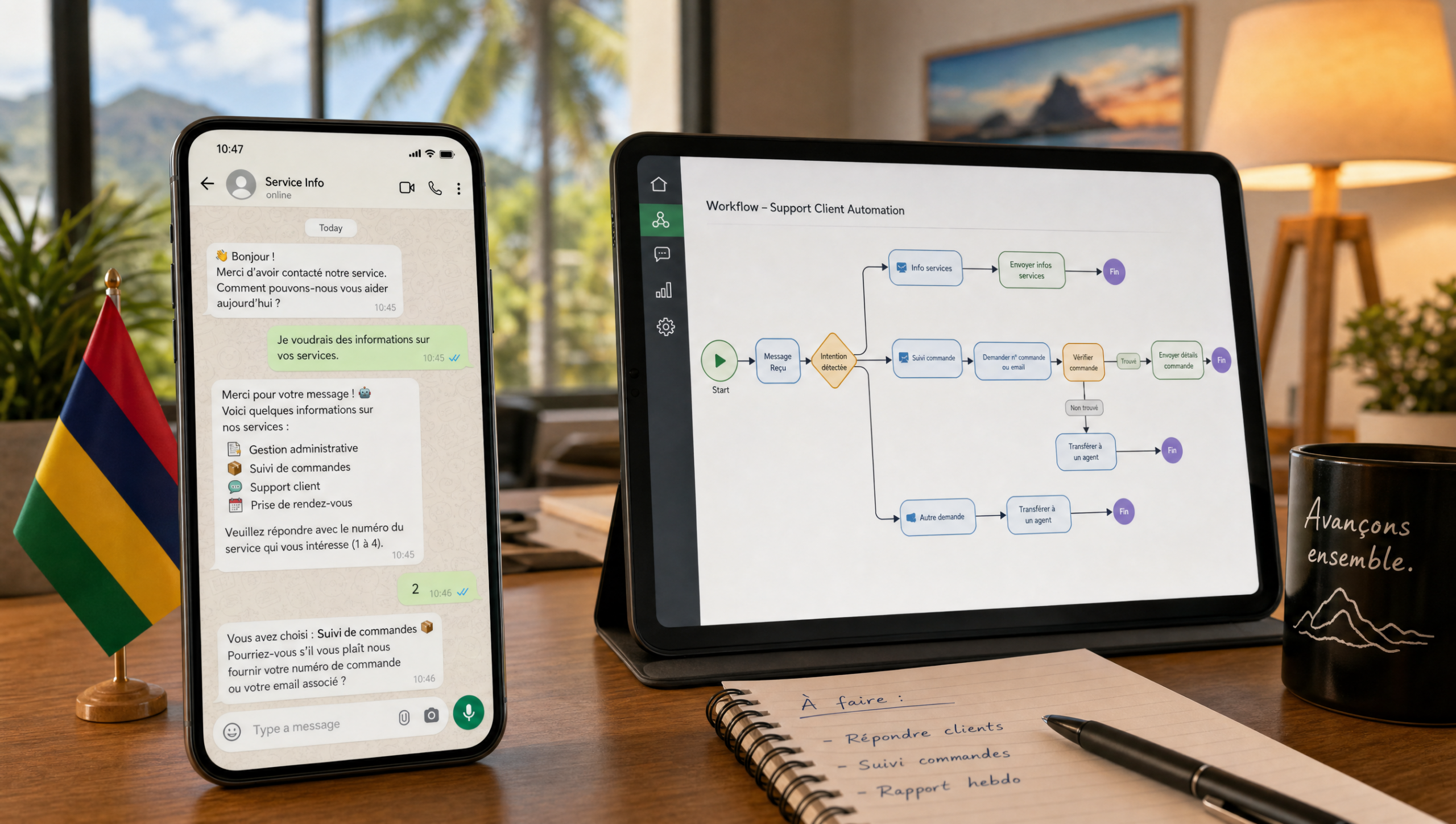
Most Mauritian SMEs we audit lose between six and twelve hours a week to admin work — chasing replies on WhatsApp, copying numbers between Excel sheets, sending the same invoice template for the fourteenth time (Digital Growth internal, from our client audits, May 2026). The first job of AI and automation here is not to do anything clever. It is to give those hours back.
Once those hours are back, then we can talk about agents, intelligence, and what comes next. Until then, every AI conversation in a Mauritian business should start with a stopwatch.
This is not what most vendors are selling you. They are selling features. We are selling a simpler proposition: time, costed in MUR, recovered in weeks.
The hours-back economics framework
The Mauritian market has roughly 124,000 SMEs (Statistics Mauritius, 2025). According to SME Mauritius, those businesses account for 42% of GDP and approximately one in two jobs on the island. What they do not have is spare capacity. Every hour an owner or manager spends on admin is an hour not spent on a client, a sale, or a decision.
Hours-back economics is the framework we use before recommending any automation. It is two steps: measure what you are currently spending time on, then calculate what that time costs in MUR. Only then does a build-vs-buy decision make sense.
How to measure your admin time honestly
The honest way is not to ask yourself how much time you spend on admin. You will underestimate.
Instead, log for one week. Every time you handle a routine task — a reply to a WhatsApp enquiry you have answered 50 times before, an invoice copied from last month’s template, a scheduling message, a follow-up reminder you wrote manually — note it. Time it if you can; estimate if you can’t.
By the end of the week, most Mauritian business owners we work with find between 6 and 12 hours of recoverable admin. Not all of it is automatable. But typically 60–70% is.
The MUR-per-hour maths for your business
Here is the calculation. Assign an hourly cost to your time — or to the staff member doing the work.
A Mauritian admin assistant earning approximately MUR 12,000/month (full-time; reference: National Remuneration Board, 2024 minimum wage guidance) costs around MUR 150/hour when you divide their monthly salary by a standard working-hours month. A business owner who could bill MUR 1,500/hour for their time is losing ten times that when they spend an hour on WhatsApp confirmations.
Run the maths:
- Hours of recoverable admin per week: 8
- Cost per hour (staff or owner): MUR 150–1,500
- Annual cost of doing nothing: MUR 62,400 – MUR 624,000
Now compare that to the cost of the automation. At MUR 40,000–180,000 to set up and MUR 5,000–15,000 per month to run (Digital Growth pricing, May 2026), even a mid-range system recovers its setup cost inside two months for most clients.
That is hours-back economics. Every other metric is a secondary claim.
The five principles
These are the five beliefs that govern how we approach automation for Mauritian businesses. Read them as a checklist. If a vendor or consultant you are talking to does not operate by at least four of them, that is worth knowing before you sign anything.
1. Hours-back economics is the only metric that matters in year one.
Every automation must show hours eliminated per week × MUR cost of those hours = saving. Anything else is a feature pitch. Ask any agency selling you automation to show you this number before agreeing to scope.
2. WhatsApp is the operating system of Mauritian commerce.
The vast majority of Mauritian SME customer interactions begin and end on WhatsApp. Automation workflows that ignore WhatsApp are designed for a market that does not exist here. Build around it, not around something more elegant.
3. Narrow agents beat wide agents, every time.
AI that does one thing reliably is more valuable than AI that does many things unreliably. A booking confirmation bot that sends the right message 100% of the time is worth more than a “general assistant” that misunderstands 20% of queries. In production, reliability beats capability.
4. CRM is a sales discipline before it is a software purchase.
Buying HubSpot or Pipedrive does not give you a sales pipeline. The discipline of capturing every lead, assigning ownership, and following up — does. The software is the ledger. The discipline is the practice. Most Mauritian SMEs that buy a CRM and stop using it after three months lost the discipline, not the software.
5. Kreol-speaking AI is here now, and your competitors have not noticed yet.
LLMs handle Mauritian Kreol well enough for short-utterance tasks — appointments, FAQs, opening hours, price enquiries. In our internal testing, Kreol-capable assistants achieve approximately 85% intent recognition for these tasks (Digital Growth internal benchmark, May 2026; tested across WhatsApp Business API flows using GPT-4o with a Kreol prompt layer). That window of competitive advantage is 12–18 months. It closes when the market catches up.
WhatsApp as your automation surface
WhatsApp is not just a messaging app for Mauritian businesses. It is the order management system, the appointment booking system, the customer service desk, and the payment follow-up tool — all in one. For most SMEs we audit, it is the closest thing they have to an ERP.
Automating WhatsApp is therefore not a communication upgrade. It is an upgrade to the operating system. That is the lens we use.
WhatsApp Business API basics in Mauritius
The WhatsApp Business app (the free one on your phone) and the WhatsApp Business API are two different products. The app works for one user on one device. The API connects WhatsApp to your systems — CRM, booking tools, payment reminders, AI models — and allows multiple users to manage conversations from a single shared inbox.
For Mauritian SMEs, the API typically comes via a Business Solution Provider (BSP) — a company such as 360dialog, Bird (formerly MessageBird), or Twilio that has access to Meta’s WhatsApp Business API infrastructure. Entry-level pricing in Mauritius runs from approximately MUR 1,500–3,000 per month (Digital Growth internal benchmark, May 2026). That covers the platform access fee; message costs are charged separately per conversation by Meta, at rates that vary by message type (marketing vs service).
The six flows that recover the most leads
Not all WhatsApp flows are equal. These six are where we see the fastest hours-back gains for Mauritian SMEs:
- Instant enquiry acknowledgement. An automated reply that fires within 30 seconds of any new message, confirming receipt and setting a response expectation. Response time is the single biggest driver of conversion for inbound WhatsApp leads.
- Booking confirmation and reminder. Once a booking is confirmed, an automated message at booking time, plus a reminder 24 hours before. For service businesses (salons, consultants, tour operators), this alone typically eliminates 2–3 hours of weekly scheduling admin.
- Lead qualification sequence. A short automated question flow that identifies whether an enquiry is qualified (budget, timeline, specific service needed) before routing to a human. Reduces time spent on underpowered leads.
- No-show follow-up. An automated message sent when an appointment is missed. Recovers bookings that would otherwise disappear without a trace.
- Post-service review request. Sent 24–48 hours after a service is delivered, asking for a Google or Facebook review. Mauritians respond well to WhatsApp follow-ups because the channel is personal. This links directly to your GEO and local search performance — see the GEO and local search in Mauritius playbook.
- Invoice reminder sequence. An automated sequence that sends a payment reminder 3 days before due date, on the due date, and 3 days after. Accounts receivable is one of the highest-friction admin tasks in any Mauritian SME. Automation does not fix late payers, but it removes the awkwardness of manual chasing.
These six flows combined can recover 6–8 hours per week for a typical Mauritian service business. Measured over a year, that is 300–400 hours — approximately 7–10 working weeks — returned to revenue-generating work.
Kreol-language WhatsApp automation
Most WhatsApp automation templates you will find online are in English. Some are in French. Almost none handle Kreol.
This matters in Mauritius because a significant portion of inbound messages from local customers arrive in Kreol — or in Kreol-French code-switching, which is arguably the most common register in informal WhatsApp communication on the island. A bot that responds only in formal English to a message in Kreol creates friction at the exact moment you need the interaction to flow.
Our approach is to build a three-language response layer: detect the language of the incoming message (English, French, or Kreol), respond in kind, and escalate to human only when the bot hits ambiguity. In practice, short-utterance tasks — ki ler zordi? (what time today?), mo kapav rezerv? (can I book?), ki prix? (what’s the price?) — are handled with approximately 85% intent recognition (Digital Growth internal benchmark, May 2026).
That 85% figure sounds modest. It means 15% of Kreol messages need human follow-up. But it also means 85% of your most common Kreol queries are answered instantly, 24 hours a day, without staff.

CRM discipline for Mauritian SMEs
Most Mauritian SMEs we audit run on three tools: Excel, Gmail, and WhatsApp. There is no formal CRM. There is no pipeline. There is a mental model in the owner’s head of who is a hot lead and who is not — and when the owner takes a week off, the pipeline disappears with them.
CRM adoption solves this. But the software is not the problem. The discipline is.
Choosing between HubSpot, Pipedrive, and Notion-as-CRM
HubSpot Starter CRM. Free at entry level (the core CRM features are genuinely free), with paid marketing tools from approximately MUR 700–1,500/user/month at current USD/MUR rates (~46.5, Bank of Mauritius, May 2026). HubSpot is strong on email marketing, lead capture, and reporting. It is also more complex than most SMEs need in year one. We recommend it for businesses with a sales team of 2+ people and a regular email marketing programme.
Pipedrive Essential. Approximately MUR 700–1,500/user/month (check pipedrive.com/pricing at live rate on draft day — SaaS pricing changes). Pipedrive is pipeline-first: its interface is built around moving deals through stages, not managing contacts in bulk. For a Mauritian service business that has 10–30 active proposals at any time, Pipedrive is often easier to adopt than HubSpot.
Notion as a lightweight CRM. Not a formal CRM — but for a solo operator or a 2-person business that is not yet ready for a structured platform, a Notion database with a deal pipeline view can be the right tool. It costs approximately MUR 300–500/user/month (Notion Plus plan, converted) and takes 2 hours to set up. It will not scale past 200 contacts, but for an early-stage Mauritian SME, it gets the discipline started.
The tool matters less than the habit: log every lead, assign an owner, record the last action, set the next one. Which software you do that in is a secondary decision.
The 14-day rollout for a Mauritian services business
A CRM is live in 14 days when you do not try to configure everything on day one.
Days 1–3: Import every existing contact from Gmail and WhatsApp into the CRM. Name only. Company. Phone. Source (how they found you).
Days 4–7: Define 4–5 pipeline stages that match your actual sales process. Not best practice — your process. “Enquiry received”, “Proposal sent”, “Awaiting decision”, “Won”, “Lost”. Move all existing leads into those stages.
Days 8–10: Set up one automation: a follow-up reminder that fires 3 days after a proposal is sent if there is no reply. That single automation pays for the CRM setup in the first month.
Days 11–14: Train every person who touches sales to log every new contact, same day. No exceptions. The system only works if it is complete.
By day 14 you have a pipeline. Not a sophisticated one — but one that exists outside someone’s head. That is the entire point of year one.
AI agents — narrow, reliable, productive
An AI agent is a software system that takes an action on your behalf — responding to a message, looking something up, filling in a form — using language understanding to interpret the input. The market is full of claims about what agents can do. The useful question is what they can do reliably, at SME scale, in Mauritius, today.
The answer is: narrow things. One job. Bounded scope. Predictable output.
Here are three cases that work.
A salon receptionist case
A Port Louis beauty salon was spending approximately 8 hours per week managing bookings via WhatsApp manually — confirmations, reminder messages, rescheduling, and no-show follow-ups — all typed by hand by the owner (Digital Growth client, anonymised, May 2026).
We implemented a WhatsApp Business API flow with four automations: instant booking acknowledgement, slot confirmation, 24-hour reminder, and no-show re-engagement. The agent does not handle complex requests — it passes anything outside the four flows to the owner. But within those four flows, it handles everything instantly, at 11 pm, on Sundays, and during peak hours when the owner is with a client.
Admin time dropped from 8 hours per week to under 1.5 hours. The salon absorbed 30% more bookings over 6 months without hiring additional staff. The cost of the setup was MUR 45,000; monthly running cost, MUR 5,500. Return on investment: within 7 weeks.
A tour-operator inbox triage case
A Grand Baie tour operator was receiving 40–60 WhatsApp enquiries per day during peak season (November–April) and responding to fewer than half within 4 hours (Digital Growth client, anonymised, May 2026). The rest went cold. In the tourism sector, a 4-hour response window is the difference between a booking and a bounce — especially for the Indian and Italian travellers who now drive Mauritius’s fastest-growing source markets (Statistics Mauritius, 2025).
A triage automation was deployed: an initial auto-reply in English and French with availability overview, pricing summary, and a direct booking link, firing within 60 seconds of every new message. Confirmed-interest leads were flagged and routed to a human via a shared inbox dashboard.
Lead recovery — the percentage of initial enquiries that reached a booking conversation — rose from approximately 35% to 62% within one quarter. No additional staff were hired. The 27 percentage-point recovery was the automation’s ROI.
An invoice-and-quote assistant case
A Quatre Bornes accountancy with three staff was generating monthly client reports manually — pulling data from two billing systems into an Excel template, formatting, and exporting as PDF (Digital Growth client, anonymised, May 2026). Each report took approximately 3 hours per client. With 22 monthly clients, that was 66 hours per month of report generation.
A Make.com workflow automation was configured to pull data from both billing systems into a unified Google Sheets template and generate a draft PDF. Report generation time dropped to approximately 20 minutes per client — a saving of roughly 55 hours per month. At a staff cost of approximately MUR 150/hour, that is MUR 8,250 per month recovered, or MUR 99,000 per year. The automation setup cost MUR 60,000. Payback period: under 7 months.
These three cases share a pattern: narrow scope, measurable output, no attempt to be clever. That is what works.

Back-office automation: invoicing, scheduling, reporting
The back office is where the most recoverable hours hide. Not because the tasks are complex, but because they are repetitive — the same actions, performed in the same sequence, every week or month.
Invoicing. Most Mauritian SMEs generate invoices manually in Word or Excel, or use a basic tool like Wave or SAGE. Connecting your CRM to your invoicing tool — so that a “Won” deal automatically generates a draft invoice — eliminates the copy-paste step entirely. For businesses issuing 20+ invoices per month, this saves 3–5 hours monthly.
Scheduling. Calendly and Cal.com both integrate with WhatsApp via Zapier or Make.com. A scheduling link in an automated WhatsApp reply eliminates the back-and-forth of finding a mutual time — often a 4–6 message exchange per booking. For a Mauritian professional services firm with 10+ consultation calls per week, that is material time back.
Reporting. The most common reporting failure we see is not that reports take too long — it is that they are not being read because they take too long to produce. A Make.com or n8n (self-hosted, free tier) workflow that pulls data from your CRM, ad accounts, and invoicing system into a single Google Sheets dashboard, refreshing automatically, replaces a weekly 2-hour manual data pull. At USD 9/month for Make.com Core (approximately MUR 420/month at current rates), this is the cheapest recoverable hour on your balance sheet.
Every copy-paste in your workflow is an automation candidate. Start there.
Pricing in MUR (setup + monthly)
Automation pricing in Mauritius has two parts: the setup (configuration, integration, testing) and the ongoing monthly (hosting, API fees, maintenance, iteration).
| Scope | Setup (MUR) | Monthly (MUR) |
|---|---|---|
| Single WhatsApp flow (e.g. booking confirmation + reminder) | 15,000–35,000 | 3,000–6,000 |
| WhatsApp Business API + 3 core flows | 40,000–75,000 | 5,000–10,000 |
| WhatsApp API + CRM (HubSpot or Pipedrive) integration | 75,000–130,000 | 8,000–15,000 |
| Full stack: WhatsApp + CRM + invoicing + reporting | 130,000–180,000 | 12,000–18,000 |
| AI agent (Kreol-capable, narrow-scope) | 50,000–120,000 | 6,000–12,000 |
(Digital Growth pricing, May 2026. Excludes WhatsApp BSP fees, Meta message costs, and SaaS platform subscriptions — these are pass-through costs priced separately.)
The MUR 5K/month automation stack
- WhatsApp Business API via 360dialog — approximately MUR 1,800/month (BSP platform fee; Meta message fees additional)
- Make.com Core — approximately MUR 420/month (5 active workflows, 10,000 operations)
- HubSpot CRM — free tier for core CRM (upgrade to Starter if email marketing is required)
- Calendly Standard — approximately MUR 1,400/month (scheduling automation with CRM sync)
- Wave (invoicing, free tier) — MUR 0/month
Total platform cost: approximately MUR 3,600–4,200/month. Add Digital Growth monthly maintenance at MUR 5,000–6,000/month, and the full running cost stays under MUR 10,000/month for a basic but functional stack.
A part-time admin assistant in Mauritius earning MUR 12,000/month (National Remuneration Board guidance, 2024) costs more than twice this stack before accounting for employer NPS contributions (~6% on the gross). The stack handles repetitive tasks. The assistant handles everything that requires judgement. That division of labour is the right one.
How we deliver automation at Digital Growth
Phase 1 — Audit (5 days). We map every admin task in your business by type, frequency, and time cost. Output: a prioritised list of automation candidates, each with an estimated hours-back and MUR-cost-out figure. If the numbers do not work, we tell you. We do not scope work that will not pay back.
Phase 2 — Architecture (5 days). We design the flow logic for the top 3–5 automation candidates. Before a single line of code or configuration is written, you approve the flow. We build nothing you have not seen.
Phase 3 — Build and test (10–15 days). Configuration, integration, and testing. We test every flow against edge cases — what happens when a customer sends a message in Kreol, what happens when a booking conflicts, what happens when the API is unavailable. We do not ship until the edge cases behave.
Phase 4 — Handover and training (2–3 days). We train your team on the system, document the flows, and hand over admin access. Your system should be yours to run, not dependent on us being available.
Total delivery timeline: 3–4 weeks for a standard engagement. We have delivered WhatsApp + CRM setups in 14 days for clients with urgent season starts.
The paid ads playbook and the websites playbook both feed into automation — ad leads land more reliably when there is a CRM and a WhatsApp flow to catch them, and WhatsApp click-to-chat on every site page is one of the highest-converting single changes you can make.
Frequently asked questions
- How much does WhatsApp automation cost in Mauritius?
- A single WhatsApp flow (for example, booking confirmation and reminders) costs MUR 15,000–35,000 to set up and MUR 3,000–6,000 per month to run, based on Digital Growth pricing in May 2026. A full stack — WhatsApp API, CRM integration, and three to five core flows — runs MUR 40,000–75,000 setup and MUR 5,000–10,000/month. These figures exclude Meta’s per-conversation message costs, which are charged separately and vary by message type.
- What is the best CRM for a small business in Mauritius?
- It depends on your sales process. HubSpot CRM (free core tier) is the default recommendation for businesses with a team of 2+ and regular email marketing. Pipedrive Essential (approximately MUR 700–1,500/user/month) is better for businesses managing an active proposal pipeline. For solo operators, a Notion database costs approximately MUR 300–500/user/month and can serve as a lightweight CRM until volume justifies a migration.
- Can AI understand Mauritian Kreol?
- Yes, to a useful level. Current large language models handle Mauritian Kreol adequately for short-utterance tasks — appointment queries, opening hours, price questions, simple FAQs. Digital Growth’s internal benchmark shows approximately 85% intent recognition for these task types (May 2026). Complex or ambiguous Kreol messages still need human follow-up, but 85% of the most common queries can be handled automatically.
- How long does it take to set up WhatsApp Business API in Mauritius?
- Meta’s WhatsApp Business API account verification typically takes 2–5 business days once all required documents are submitted. The automation flows themselves take an additional 1–2 weeks to build and test. A standard single-flow setup can be live in 14 days.
- Will automation replace my staff?
- No. Automation handles tasks that do not require human judgement — confirmations, reminders, data pulls, invoice generation, follow-up sequences. The staff time freed by those automations is time for client work, problem-solving, and the things that actually grow a business. Every automation project Digital Growth delivers increases revenue-generating capacity; none has reduced headcount.
- What is the ROI timeline for automation in Mauritius?
- For a MUR 40,000–75,000 WhatsApp + CRM setup with MUR 5,000–10,000/month running costs, payback is typically 2–4 months for a Mauritian service business running 10+ bookings or 15+ leads per week. The fastest paybacks come from tour operators in peak season. The slowest — around 6 months — come from businesses with lower inbound volume who benefit more from invoicing and reporting automations.
Ready to get your hours back?
Book a free 30-minute automation audit. We will map the top three admin tasks in your business, estimate the hours and MUR recoverable, and tell you honestly whether automation makes sense for your current volume and budget.
No feature pitch. No hourly rate. A conversation about your stopwatch.
