Websites in Mauritius: fast, bilingual, built for what comes next
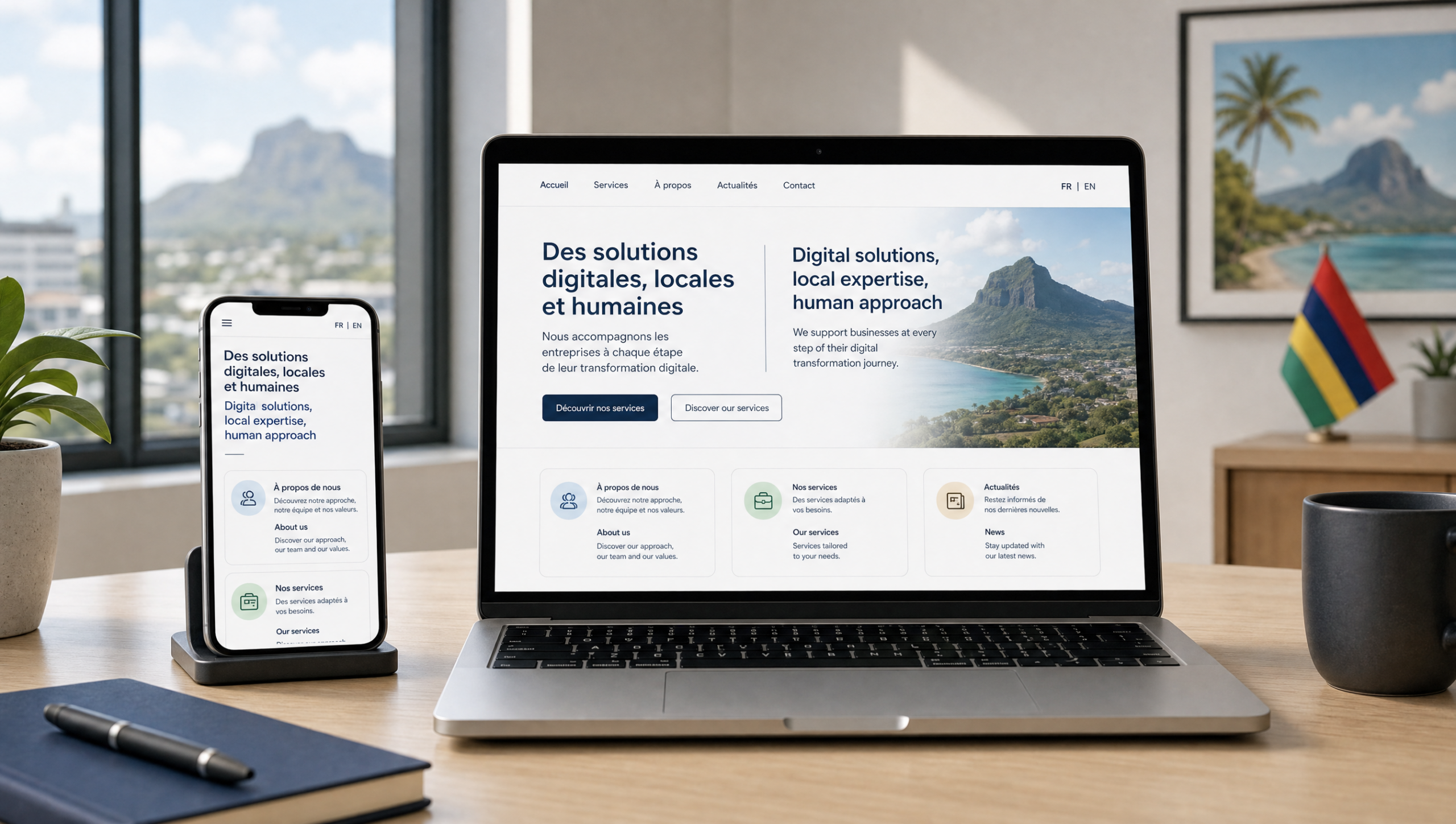
A website’s job is not to look good. It’s to load on a Mauritian phone in under two seconds, speak whichever of three languages the user prefers, and route them to the next step — usually a WhatsApp message — without making them think. Almost everything else most agencies will tell you about your website is a distraction.
Speed. Bilingual architecture. One clear action. That’s the brief.
Everything else — the colour palette, the animation library, the framework — is downstream of those three things. We have audited over 40 Mauritian websites. Every one of them had a beautiful design. Most of them were quietly haemorrhaging leads.
Why your current website probably underperforms
If your site is three or more years old, you’re unlikely to be the exception. Most Mauritian websites are failing on at least two of the three axes above. Not because the original build was careless, but because the goalposts have moved — and most agencies never revisited the build to check.
The mobile latency problem
Mauritius has excellent mobile infrastructure. Mauritius Telecom completed nationwide 5G deployment in June 2024, becoming the first national telco to achieve full island coverage (Extensia Tech / Mauritius Telecom). Ookla ranked Mauritius 38th globally in mobile speed in mid-2024. Average mobile broadband download speeds on the my.t network reached 156 Mbps by Q3 2025.
So the network isn’t your problem. Your hosting is.
Most Mauritius websites are hosted on European servers — typically in Amsterdam, London, or Paris. The round-trip from a Mauritian phone to one of those servers and back takes 200–400ms before a single byte of your page has been requested. Every request for a font, an image, a CSS file, adds to that stack. By the time the browser renders your page, a user on Orange or Emtel may have waited three or four seconds — and left.
According to the Deloitte and Google “Milliseconds Make Millions” study (a global benchmark, not Mauritius-specific), a 0.1-second improvement in mobile site speed increases conversions by 8.4% for retail and 10.1% for travel. The maths works in Mauritius too.
The bilingual hreflang problem
Almost every agency in Mauritius offers “bilingual websites.” Almost none of them explain what bilingual done wrong looks like.
A bilingual site configured without correct hreflang tags is telling Google two contradictory things at once: “this page is the English version” and “this page is also the French version.” Google resolves this by picking one, ignoring the other, or — worst case — flagging the pair as duplicate content. Your SEO equity splits. Your French and English pages compete against each other. You’ve paid for two sites and got half the benefit of one.
We have audited bilingual hreflang on Mauritian sites. It is broken on the majority of them. This is not a small technical footnote — it’s the difference between ranking for “agence marketing Maurice” and not.
The “agency dependency” problem
The third failure mode is quieter but longer-lasting. Your site is beautiful, it loads reasonably quickly, the hreflang is set up. But to change the homepage headline, you have to email your developer. To add a new team member, you raise a ticket. To update a price, you wait a week.
This is not a technical problem. It’s a contract problem. Many Mauritius agency builds are configured to maximise developer time — not client autonomy. CMS access is restricted, editing is discouraged, and the annual maintenance retainer locks in the relationship.
A website you can’t update is a brochure, not a sales asset.
The five principles
Before we get into the how, the principles. These are the beliefs we build every site around. If your current agency can’t articulate something similar, that’s a signal.
1. Speed compounds. Every 100ms of latency is an invisible tax on your conversion rate. We optimise for Mauritian mobile networks specifically — not desktop Lighthouse scores.
2. A bilingual site is two sites in a trench coat. Built without discipline, it cannibalises itself. Built with correct hreflang, shared infrastructure, and adapted (not just translated) copy, it doubles your addressable market overnight.
3. The CMS choice determines who owns the site over five years. We build for client independence. You should be able to update your own site without calling us.
4. WhatsApp is the conversion layer. For Mauritian SMEs, the most reliable contact-form submission is a WhatsApp click-to-chat link. We design for where users actually end up — not where form-conversion best-practice says they should.
5. Direct booking is a strategic asset for tourism operators. Every booking that goes through an OTA gives away 15–25% of the room rate. A direct-booking site does not eliminate OTAs — it rebalances the channel mix in your favour.
WordPress, headless, or no-code — choosing for Mauritius
This is the question most agencies answer with the tool they know best. We try to answer it with the use case you actually have.
Decision grid by use case
Use case
Recommended CMS
Why
SME services site (law firm, accountant, consultant)
WordPress
Easy updates, bilingual plugins mature, lower cost, TINS grant eligible
E-commerce (physical products, WooCommerce)
WordPress + WooCommerce
53.9% of Mauritius e-commerce stores run WooCommerce (BrandNav, January 2025); ecosystem deep
Fast-growing e-commerce (high SKU count, global)
Shopify
Shopify stores in Mauritius grew 18% year-on-year in Q2 2025 (StoreLads); best for scale
Tourism / villa / boutique hotel
WordPress + booking plugin
Direct-booking integration, bilingual support, client can update availability
Content-heavy site (news, magazine)
WordPress
Native editorial workflow; no dev needed for day-to-day publishing
Enterprise / custom platform
Headless (Sanity + Next.js or similar)
Performance ceiling higher; worth the cost only above MUR 500K+ budget
Solopreneur / MVP / test concept
No-code (Webflow, Framer)
Fastest to launch; suitable if FR/EN is not required and conversion is simple
When WordPress wins
For the majority of Mauritian SMEs, WordPress is still the right answer. Not because it’s the best-performing framework — it isn’t. But because the total cost of ownership over five years, including maintenance, client updates, bilingual plugin support, and developer availability in Mauritius, tilts firmly in its favour.
WordPress powers 43.2% of websites globally (W3Techs, May 2026) and the Mauritius developer ecosystem reflects this. Finding a WordPress developer in Ebene or Grand Baie is straightforward. Finding a Nuxt.js developer who understands Mauritian hreflang requirements is considerably harder.
Importantly, WordPress builds are eligible for the TINS grant administered by SME Mauritius. Qualifying businesses (annual turnover below Rs 100M, registered in Mauritius, trading for 6+ months) can claim 80% of development costs up to Rs 200,000. That means an Rs 120,000 WordPress build costs the SME Rs 24,000 out of pocket. Almost no competitor page in Mauritius mentions this.
When headless wins
Headless is the right call in a narrow set of situations: you have a content team publishing hundreds of articles a month, your developer is comfortable with a JavaScript framework, and your budget clears MUR 500,000 for build plus ongoing maintenance.
For most Mauritian SMEs, that set of conditions is never true simultaneously. What headless buys you is a performance ceiling and editorial flexibility at scale. What it costs you is developer dependency. If your developer leaves Mauritius or raises rates, you are stuck — unless you’ve paired the headless back-end with a CMS surface like Sanity or Strapi that a non-developer can navigate.
If a Mauritius agency is pushing you toward headless for a Rs 150,000 site, ask them to walk you through what happens when you want to add a page without their involvement. The answer will tell you a lot.
When no-code is enough
For a solopreneur testing a concept, a popup event with a three-week window, or a landing page for a single campaign, no-code is fine. Webflow and Framer are both capable of fast, good-looking sites. Neither handles bilingual hreflang well at the SME level. Neither gives your developer the deployment control you need for a long-term site. Use them for what they’re good at — speed to launch on a tight budget — and don’t let an agency sell them to you as a long-term solution for a multi-language Mauritian business.
Bilingual architecture done right
Mauritius runs on English, French, and Kreol. English carries government, education, and B2B. French carries B2C, media, and the majority of consumer marketing. Kreol is the lingua franca — it’s not yet well-supported by Google Translate as a target language, but it lives in voice search, near-me queries, and WhatsApp conversations (Statistics Mauritius; DataReportal Digital 2025 Mauritius).
A bilingual site that doesn’t recognise these three distinct contexts will under-serve at least one of them.
WPML vs Polylang vs subdomains — Mauritian recommendation
WPML is the industry standard for WordPress multilingual. It handles hreflang correctly, integrates with WooCommerce, and supports page builder plugins. The downside is cost (Rs 7,000–15,000 per year depending on plan) and configuration complexity — WPML configured incorrectly produces worse hreflang than no multilingual plugin at all. We use WPML on complex builds where WooCommerce or a custom post-type structure requires it.
Polylang is the free (or low-cost) alternative. It handles straightforward EN/FR content translation well and sets up hreflang correctly when configured properly. For a services site without e-commerce, Polylang is our default. The Polylang Pro version (Rs 4,000–6,500/year) adds support for WooCommerce and more complex taxonomies.
Subdomain architecture (en.yourbrand.mu / fr.yourbrand.mu) is the cleanest SEO structure for sites where the EN and FR audiences are genuinely distinct. Each language is treated as a separate property, with its own crawl budget, link equity, and ranking trajectory. The trade-off is management overhead — updates must be maintained across two properties. For SMEs, we generally recommend subdirectories (/en/ and /fr/) over subdomains unless the French and English versions have materially different products or audiences.
Our Mauritius recommendation: Polylang Pro for most service businesses. WPML for e-commerce. Subdomains only when the two languages serve distinct enough audiences to warrant separate SEO strategies.
Hreflang for FR/EN parity
The hreflang tag tells Google which language and region each page targets. For a Mauritian business with an FR and EN version, the tags look like this:
Both language versions must reference each other. If only the EN page references the FR page (but not vice versa), Google ignores the tag entirely. This is the single most common bilingual implementation error we see on Mauritius sites — and it’s invisible unless you specifically audit for it.
Translating once vs adapting twice
There is a difference between translating a page and adapting it. Translation gives you the same page in another language. Adaptation gives you the version of that page that would have been written natively by a French-speaking Mauritian for a French-speaking Mauritian audience.
The FR-speaking SME owner querying “création site web Maurice” is not looking for the same content as the English-speaking reader — different formality register, different price sensitivity signals, different decision triggers. A machine-translated page will rank for neither. A properly adapted page ranks for both.
Speed for Mauritian mobile networks
The infrastructure point bears repeating: Mauritius has fast networks. The problem is not bandwidth — it’s where your server sits in relation to your users.
A Mauritian phone connecting to a server in Amsterdam makes a round-trip of roughly 200–400ms per request (historical benchmark; since the opening of Cloudflare’s Mombasa PoP, cached assets now reach Mauritian users in approximately 50ms). That gap matters. It’s not theoretical — it shows up in your bounce rate.
Speed call-out: According to DataReportal (January 2025), there are 2.14 million mobile connections in Mauritius, of which 95.8% are broadband-capable. Among adults aged 20–29, online penetration reached 98.6% (Statistics Mauritius ICT Survey, 2024). Your Mauritian audience is mobile-first, connected, and impatient. A 3-second load time costs you an audience that has a 156 Mbps connection and no tolerance for slow sites.
Hosting choices (local vs global CDN)
Three configurations are common for Mauritius sites, in ascending order of performance:
European-hosted without CDN. The default for most builds. Cheapest. Worst for Mauritius. Latency 200–400ms per round-trip.
European-hosted with Cloudflare CDN (free tier). A significant improvement for static assets. Cloudflare’s Mombasa PoP now routes East African and Indian Ocean traffic, reducing cached-asset latency to ~50ms. This is the minimum acceptable configuration for any new Mauritius build.
Local hosting (Mauritius Telecom / local provider) with CDN overlay. Lowest first-byte latency for dynamic content (database queries, server-side rendering). Best for content-heavy WordPress sites or WooCommerce stores with large catalogues.
For most SME builds, Cloudflare CDN on a mid-tier European or South African host (JNB PoP) hits the right cost/performance balance. Commission a GTmetrix or WebPageTest run from a Mauritius-region origin server before signing off on any new build.
Image and font diet
Images and Google Fonts are the two most common performance killers on Mauritius sites, and they are both entirely avoidable.
Images: every image should be served in WebP format, sized to the actual display dimensions, and lazy-loaded below the fold. A 4MB hero image served to a mobile phone is not a design decision — it’s a technical failure. We’ve seen Mauritius site audits where a single uncompressed image adds 2.5 seconds to load time.
Fonts: Google Fonts load from Google’s servers, adding a DNS lookup and at minimum one round-trip. Either self-host your fonts (copy the files to your own server) or use a font subsetting service to serve only the characters you need. For French and English Mauritian content, you rarely need more than the Latin extended-A character set.
Critical render path audit
The critical render path is the sequence of events the browser must complete before it can paint the first visible pixel. Every render-blocking script or stylesheet in the head of your page delays this sequence.
A practical Mauritius audit checklist for new builds:
Inline critical CSS; defer everything else
Load JavaScript in defer or async mode
Preload your largest contentful paint (LCP) image
Set explicit width and height on all images (prevents layout shift)
Serve fonts from your own domain, not Google’s
Enable HTTP/2 on your server (most modern hosts do this by default)
Run Core Web Vitals in Google Search Console before and after any optimisation sprint. Aim for LCP under 2.5 seconds and CLS below 0.1 — measured on mobile, on a Mauritius-region test.
Direct-booking sites for tourism operators
Mauritius recorded 1,436,250 tourist arrivals in 2025, up 3.9% year-on-year, with tourism earnings reaching Rs 93.6 billion (~USD 2.0 billion) (Statistics Mauritius / AHRIM). The sector is large, and the commission economics for individual operators are brutal.
The OTA-bypass economics
Booking.com charges independent properties between 15% and 18% commission per booking. Expedia charges 15–30% (Cloudbeds OTA Commission Guide, 2026 — global figures). For a boutique Mauritius villa with an average nightly rate of MUR 25,000, a 15% Booking.com commission represents MUR 3,750 per booking.
A villa receiving 200 bookings per year, 80% through OTAs, pays approximately MUR 450,000–540,000 in OTA commission annually. Shifting just 25% of those bookings to a direct channel — achievable with a properly designed direct-booking site, a loyalty mechanism, and targeted email or WhatsApp follow-up — recovers approximately MUR 112,500–135,000 per year. That’s enough to pay for a well-built booking site in the first year of operation, and to pocket the rest in subsequent years.
OTA commissions are a website tax you chose not to fight.
Booking-flow design
The difference between a direct-booking site that converts and one that doesn’t is rarely the design. It’s the booking flow.
1. Reduce steps. A user who has to fill in a contact form to get availability, then wait for a reply, then receive a payment link, then pay — loses interest after step one. Use a booking widget (Checkfront, Lodgify, Beds24, or similar) that shows live availability and takes payment in the same session. MUR-denominated pricing with MCB Juice or card payment support is not optional for the local market.
2. Show the direct-booking benefit. State clearly, on every page: “Book direct and save 10%” or “Book direct for our best rate guarantee.” Users know OTAs exist. Give them a reason to stay on your site.
3. Capture email and WhatsApp before checkout. Even an abandoned booking is a warm lead. A partial checkout or a “check availability” query should trigger an automated WhatsApp or email follow-up within 30 minutes. This is not a luxury feature — it’s table stakes for a direct-booking site that earns its keep.
WhatsApp as the conversion layer
This one is blunt: nobody in Mauritius fills out a contact form on their phone. They close the tab and open WhatsApp.
Contact forms sit on your website. WhatsApp lives on the home screen. The friction differential is enormous, and the Mauritian SME market runs on WhatsApp Business — almost by default. WhatsApp Business API entry-level plans run MUR 1,500–3,000 per month in Mauritius.
Globally, WhatsApp-initiated conversations convert at approximately 66% to a completed enquiry or purchase, compared to ~3% for web forms (industry benchmark — not Mauritius-specific). Our own client data suggests the gap is at least as wide in Mauritius, where WhatsApp is the primary business communication channel for SMEs (Digital Growth internal benchmark, 2026).
What this means in practice for your build:
Every service page has a WhatsApp click-to-chat button, not just a contact form.
The button is pre-populated with a message: “Hi, I found you on your website and I’d like to know more about [service].” Users don’t have to think about what to type.
The button is visible above the fold on mobile — not hidden in the footer.
On tourism sites, the WhatsApp button is your direct-booking fallback. If the booking widget is too slow or the user has a question, WhatsApp catches them before they bounce.
This is not about replacing your booking system or your CRM. It’s about acknowledging where Mauritian users actually go when they want to make contact — and meeting them there.
Pricing in MUR
Most Mauritian web agencies don’t publish prices. We do.
All prices exclude hosting, domain, and ongoing maintenance. Monthly retainer for hosting, security monitoring, and minor updates typically runs MUR 5,000–15,000/month.
A note on the TINS grant
If you are a Mauritian SME with annual turnover below Rs 100 million, trading for at least six months, the Technology and Innovation Scheme (TINS) administered by SME Mauritius covers 80% of eligible digital investment costs up to Rs 200,000 per business (active scheme confirmed May 2026).
That means an Rs 180,000 WordPress build costs you Rs 36,000 out of pocket. An Rs 220,000 bilingual build costs Rs 44,000. The grant is real, it is under-used, and almost no agency in Mauritius mentions it in their pricing conversations. We do.
Ask us about TINS eligibility when you book your audit.
How we build sites at Digital Growth
We follow a six-stage process on every build. There are no surprises mid-project, and no scope creep that you didn’t authorise.
Discovery and audit (week 1–2). We audit your existing site — Core Web Vitals, hreflang, conversion paths, hosting configuration — before proposing anything. If your current site can be fixed for MUR 30,000 rather than rebuilt for MUR 200,000, we’ll tell you.
Architecture and wireframes (week 2–3). Before any design, we agree on the page structure, the CMS choice, the bilingual architecture, and the conversion flow. You sign off in writing.
Design (week 3–5). Design in Figma against your agreed brand guidelines. Two revision rounds included. We design mobile-first — not as an afterthought.
Build and content (week 5–9). WordPress build against the signed-off design. Content written in EN and FR by our team or loaded from your existing copy. All images optimised for WebP and performance.
Performance and hreflang QA (week 9–10). GTmetrix test from a Mauritius-region proxy. Google Search Console hreflang validation. Core Web Vitals pass: LCP under 2.5s on mobile; no critical CLS issues.
Launch and handover (week 10). You receive full admin access, a 60-minute training session, and a written guide to making the most common updates yourself. Your site belongs to you — not to us.
Frequently asked questions
How much does a website cost in Mauritius?
A properly built bilingual WordPress site for a Mauritius SME runs MUR 140,000–220,000 (roughly €2,800–€4,400). Single-language builds start at MUR 80,000. E-commerce and tourism sites with booking integration typically run MUR 180,000–350,000. If you are a qualifying SME, the TINS grant from SME Mauritius can cover 80% of costs up to Rs 200,000 — reducing your out-of-pocket to as little as Rs 36,000 on a mid-range build.
Which CMS is best for a Mauritius business website?
For most Mauritius SMEs, WordPress is the right choice — it’s the platform with the deepest local developer ecosystem, the most mature bilingual plugins (WPML and Polylang), and a client editing experience that doesn’t require a developer for routine updates. WooCommerce (built on WordPress) powers 53.9% of e-commerce stores in Mauritius (BrandNav, January 2025). Headless CMS is justified only for enterprise builds above MUR 500,000 or for content teams publishing at high volume.
Does my Mauritius website need to be in Kreol as well as English and French?
Not necessarily, but you should know where Kreol appears in your funnel. Kreol is the lingua franca in Mauritius — it lives in voice search, near-me queries, and WhatsApp conversations. Google does not currently support Kreol as a hreflang target language. In practice, Kreol content belongs in WhatsApp templates, social media captions, and conversational micro-copy — not as a third structured language version of your website.
How do I reduce OTA commission for my hotel or villa?
By building a direct-booking site with a best-rate guarantee, live availability via a booking widget (Lodgify, Beds24, Checkfront), and a WhatsApp follow-up flow for abandoned enquiries. Shifting 25% of bookings from OTA to direct on a 200-booking year can recover MUR 112,500–135,000 in commission savings at typical Mauritius villa rates. The site build cost pays for itself in the first year.
How fast should a website load on a Mauritian phone?
Google’s Core Web Vitals benchmark targets LCP (Largest Contentful Paint) under 2.5 seconds on mobile. For Mauritius sites, measure using a mobile test from an East Africa or Mauritius region origin. With Cloudflare CDN and correct image optimisation, hitting this threshold on a WordPress build is consistently achievable. Aim for LCP under 2.5s and a CLS score below 0.1.
What is the difference between WordPress and a headless CMS for a Mauritius business?
WordPress couples the content management back-end with the website front-end — you log in and edit pages directly. Headless separates the two, giving you a higher performance ceiling but requiring a developer for structural changes. For most Mauritius SMEs, the developer dependency cost of headless outweighs its performance benefits below MUR 500,000 in build budget.
Ready to find out what your site is actually doing wrong?
A free site audit from Digital Growth covers three things: Core Web Vitals on Mauritius mobile, bilingual hreflang correctness, and conversion path analysis. We’ll tell you exactly what’s costing you leads, whether the fix is a simple configuration change or a rebuild, and — if a rebuild is warranted — what it would cost and whether your business qualifies for the TINS grant.
No sales pitch. No proposal unless you ask for one.
Book your free site audit →